

Discover the Creativity of the Future: Use 3D Printing to Bring Your Ideas to Life
Suite 20-01 & 20-02B, Level 20 The Pinnacle, Persiaran Lagoon, Bandar Sunway, 47500 Subang Jaya, Selangor, Malaysia
hello@custommetal3dprinting.com
+60 124838830
Testing flexible seals on an engine dynamometer demands investment in parts able to withstand thermal shock, not eye-catching prototypes. Extrusion methods are inadequate to the challenge of processing liquid silicone rubber, leaving engineering teams stuck in the slow purgatory of finding functional elastomers. Our Silicone 3D Printing Service handles the physics of photopolymerization and urethane casting so you can accelerate clinical trials without draining your R&D budget.
Table of Contents:
Consulting this matrix saves weeks of trial-and-error testing on the test bench, aligning your thermal expectations and purchase volumes to the optimal elastomeric manufacturing process.
Extrusion 3D printing works by melting thermoplastic filaments and forcing the liquid polymer through a heated brass nozzle. Liquid silicone rubber is a two-part thermoset with an extremely high viscosity that cannot be forced through a printing nozzle. You have to bypass standard extrusion and use specialized light-curing equipment for Silicone 3D Printing.
P3 DLP machines use UV light to activate a vat of engineered silicone photopolymer, instantly polymerizing the liquid into a resilient elastomer. The printed part is isotropic in nature, providing greater resistance to delamination under heavy tensile stress along the Z-axis.
Automotive engineers testing engine components have to consider the severe environment under the hood. You cannot simply print a TPU seal and expect it to hold up next to a hot manifold. Direct printing of a true 40A silicone resin provides total flame resistance.
Silicone resins we print can be tested in 1,000-hour thermal aging chambers at 150°C. Your team can mount actual prototypes on a working engine block to simulate fluid dynamics before committing to metal tooling.
Printing medical devices often requires 1 to 20 highly customized iterations. Hearing aids and CPAP masks need to be comfortable and reliable, requiring an exacting anatomical fit.
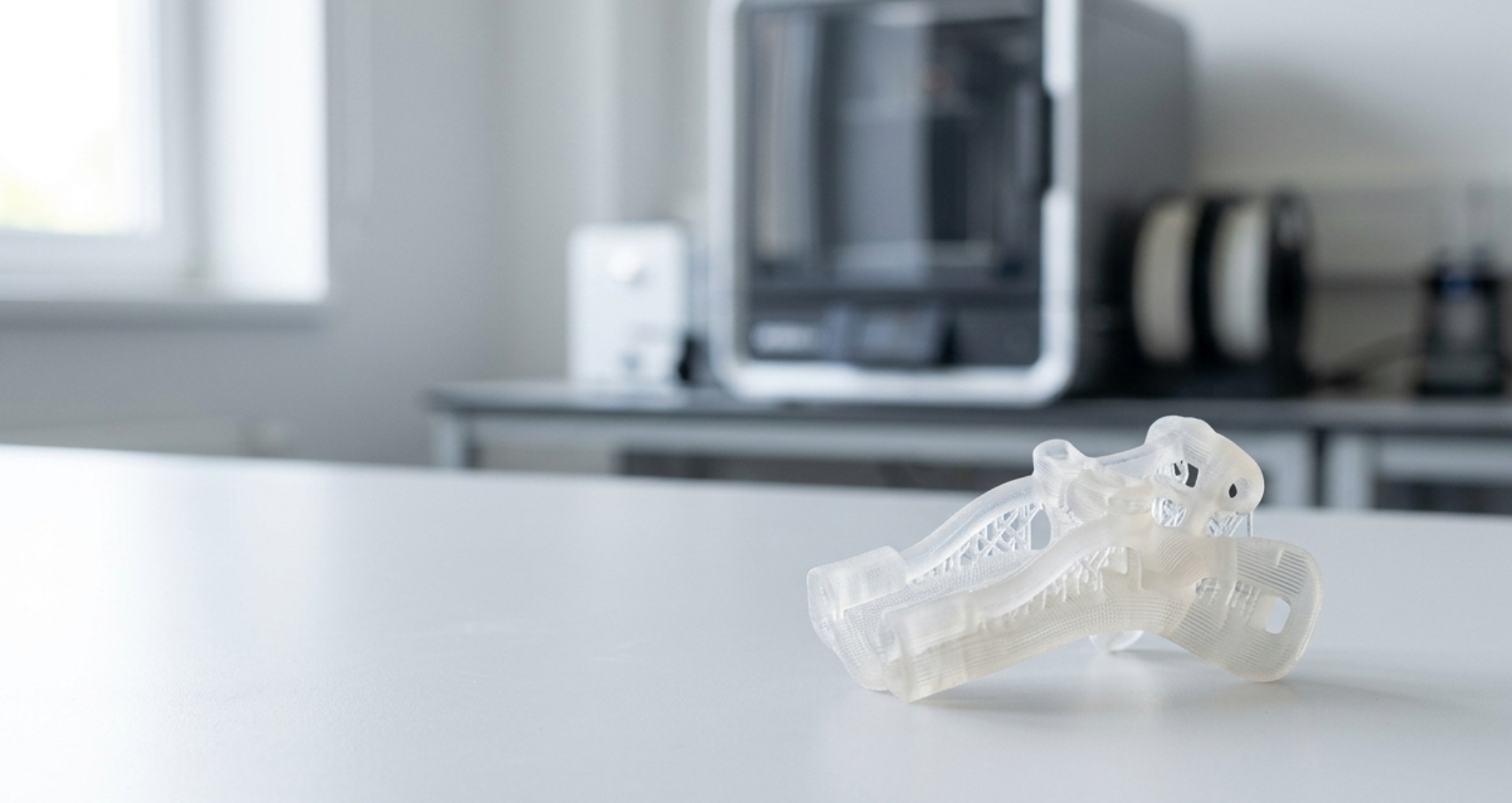
Printing direct from medical-grade silicone resin lets you skip the tooling and get testable, skin-ready devices to your trial patients in days. You can iterate rapidly on biocompatible CPAP masks while using 3D Printing For Silicone Masks to develop comfortable, patient-specific solutions in a sterile environment.
Many hardware start-ups do not need the thermal stability of liquid silicone in their prototypes. You can print a flexible TPU or standard SLA resin to simulate the tactile feel of real silicone. Your design team can iterate rapidly on the ergonomic fit and housing dimensions.
Flexible SLA resins snap back under stress, failing repeated mechanical testing. You have to keep these ersatz elastomers strictly for indoor ergonomic validation.
When working with harsh solvents or UV radiation, a flexible resin enclosure will degrade within days. Print a silicone-like resin only for tactile validation, always assuming the part is a single-use soft tool.
Pro tip: Cannot decide between real silicone and ersatz alternatives? Contact us to receive RapidDirect’s Free Material Sample Box. Physically evaluate our TPU elastomers and cast LSR’s mechanical performance to help you select materials for your assembly.
Waiting for regulatory approval to machine a steel mold for your implantable device ties up your R&D budget in a 10k USD time-waster. The low-volume manufacturing hack requires printing a rigid SLA mold and casting real LSR rubber into it. This Silicone Mold 3D Printing approach helps you avoid the costs of steel molds entirely while obtaining silicone parts with the same tensile properties as injection-molded LSR.
New product introduction (NPI) teams for automotive suppliers exploit this method to obtain vibration-damping boot seals for initial suspension testing.
Printing a master mold on an industrial SLA printer lets you print multi-cavity molds at 0.05 mm resolutions. You can obtain extremely close dimensional tolerances of ±0.1 mm to 0.15 mm on the final cast silicone rubber parts. This level of accuracy is useful for high-tolerance fluid manifolds and complex medical catheters.
The process of urethane casting lets you select from a wide array of true LSR durometers. Softer 10A silicones provide better compression for low-pressure enclosures. Choose 60A LSR for heavy-duty industrial gaskets and machine tool dampeners.
Cast LSR parts naturally resist degradation from common hydrocarbon solvents. If your system requires total fluid containment, cast silicone is much safer than standard 3D printed parts. The liquid rubber effectively fills all the microscopic pores in a 3D printed mold, obtaining a watertight consistency with no risk of leaks.
EV battery enclosures demand massive rubber seals to prevent shorting from water ingress. Validating the performance of these large gaskets using standard tooling costs tens of thousands of dollars before the first test drive.
Casting LSR rubber into a large-format SLA printed mold lets NPI teams simulate IP67 water resistance on an actual vehicle chassis. You can validate the compression set of the molded gasket and speed up your launch timeline.
Modern hardware products always demand soft-touch interfaces bonded to rigid housing structures. Bonding a printed silicone grip to a polycarbonate housing creates weak points on your assembly line. Our facility supports overmolding and two-part casting to permanently fuse printed and cast parts together.
Print a rigid grip interface, place it inside a second SLA mold cavity, and inject LSR over it to permanently bond the two sections together. Injecting liquid silicone rubber over a printed core creates powerful chemical bonds that can survive factory floor abuse. Properly designed mechanical interlocks between the rigid and flexible parts are necessary to avoid peeling during impact testing.
Engineers designing molds for LSR casting always have to follow specific guidelines to prevent failures from warping or trapped air. Thicker walls of silicone rubber shrink more than thinner sections during cure, creating sink marks on the inside of the part. Design molds to have consistent wall thickness to prevent severe deformations on critical sealing surfaces.
Bubbles trapped inside a printed mold will create weak spots in your cast part. Always incorporate ample venting and escape channels, especially on the top surfaces of your molds. Proper gate sizing lets the highly viscous LSR charge the mold cavity completely before curing begins.
Bypassing the markup of third-party marketplaces gives you greater control over the manufacturing process. RapidDirect owns a 20,000㎡ in-house facility to maintain quality certifications, giving your R&D team a 30% cost advantage versus third-party quoting. You can cut out error-prone middlemen by speaking directly to the engineers manufacturing your parts.
Upload your elastomer designs to our site for instant Design for Manufacturability (DFM) analysis, catching thin-wall dimensional risks before committing to production. Try our service to beat the delays of standard quoting, obtaining validated parts at 3–5 day lead times. We handle the production compliance so your team can focus on developing ground-breaking medical devices and automotive systems.
Ready to bring your project to life? Get In Touch with our engineering team to learn more about our solutions.
Printing real silicone resins becomes cost-effective when you need between 1–20 customized iterations. You begin to see cost advantages when printing a rigid SLA mold for LSR casting between 20–500 units. Orders above 1,500 units should consider traditional injection molding for even better value.
Our factory maintains ISO 9001 and ISO 13485-compliant quality control standards to ensure batch consistency. We have strict processing guidelines for the vacuum degassing and curing steps to prevent defects. We supply the necessary CMM inspection reports and material datasheets to prove the conformance of every medical or automotive component.
Yes. Injecting medical-grade LSR silicones into a 3D printed mold satisfies ISO 10993 biocompatibility standards. We have the right surface finishing techniques to prevent cytotoxicity failures from machining. This method is ideal for low-volume custom orthopedic pads and medical device testing.
