


Material Shelf Life, Storage, And Handling Best Practices For 3D Printing
A hands-on approach keeps results steady while blocking unwanted material mix-ups during printing processes.Most times, how your material behaves matters way more than how advanced the printer is when you’re building something layer by layer.When teams handle powders, resins, and filaments carefully, things go right more often. Mistakes happen less. Blame shifts elsewhere when control slips – often toward the machine.What really counts at work shows up in how things get done each day.
Table of Contents:
Shelf Life Impact on Powders, Resins, and Filaments
Metal Powders
Most stay usable one to three years if kept sealed in moisture-proof wraps. After opening, just a small amount of damp – say 0.1 or 0.2 percent – makes them clump up, melt poorly, leave bubbles behind, weaken structure here and there.
Real Shop Scenario
One morning, the usual metal powder started causing bubbles in parts – no one expected it. Left uncovered between shifts, the bin soaked up humidity overnight. Dust drifted in from nearby work areas too. The Local 3D Printing Services functioned exactly as programmed. Changes came only after air reached the material.
SLS Polymer Powders
Most manufacturers suggest mixing no more than 30 to 40% fresh material into recycled powder, just to keep strength steady. When powder circulates too long through machines, parts snap easier, stretch less before failing, while outer layers turn uneven in texture.
Example
A corner curling issue at an SLS print shop led back to damp air sneaking into the material container. Moisture climbed inside the PA12 granules once humidity entered. Spreading became uneven only after the grains absorbed excess water.
SLA And DLP Resins
Most batches stay steady about a year after production, provided storage is proper. A change in thickness – say from 700 mPa·s up to 900 mPa·s – might lead to weak curing, warped shapes, missing small features.
Example
A clear SLA resin began to thicken and shift toward yellow – simply sitting too close to a warm exhaust outlet from nearby equipment. Dimensional accuracy of High-Precision 3D Printing Services in Malaysia parts dipped soon after. Once relocated away from heat, stability returned. Temperature management made the difference.
Filaments
Water loves clinging to nylon and TPU because they’re thirsty materials. Humidity pulls it in fast – sometimes two percent by weight before long. Steam bursts form when that wetness hits hot metal inside the 3D Printing Services in Malaysia head. Little explosions happen there. They leave behind holes, thin threads between parts, layers that won’t stick right.
Example
A plastic reel sat outdoors in sticky air, picked up damp by morning. Humidity made 3D Printing Technologies turn muffled, like voices through cloth. Heating the coil cleared things up – detail returned slowly. No magic fix, just time near warmth doing its job.
Storage Conditions: Humidity, Light, and Temperature
Should moisture find its way into stored materials, trouble follows. Darkness matters just as much as low humidity. Temperature swings invite decay. Stability isn’t optional – it’s built into longevity.
Practical Storage Targets
- Moisture ruins metal powders – keep humidity below ten percent. Top aerospace facilities aim closer to five percent.
- Below 20% humidity, SLS powders work most effectively. At roughly 35%, moisture causes them to stick together and creates uneven layers.
- Darkness suits resins best. Store them between 20 and 25°C in light-blocking containers.
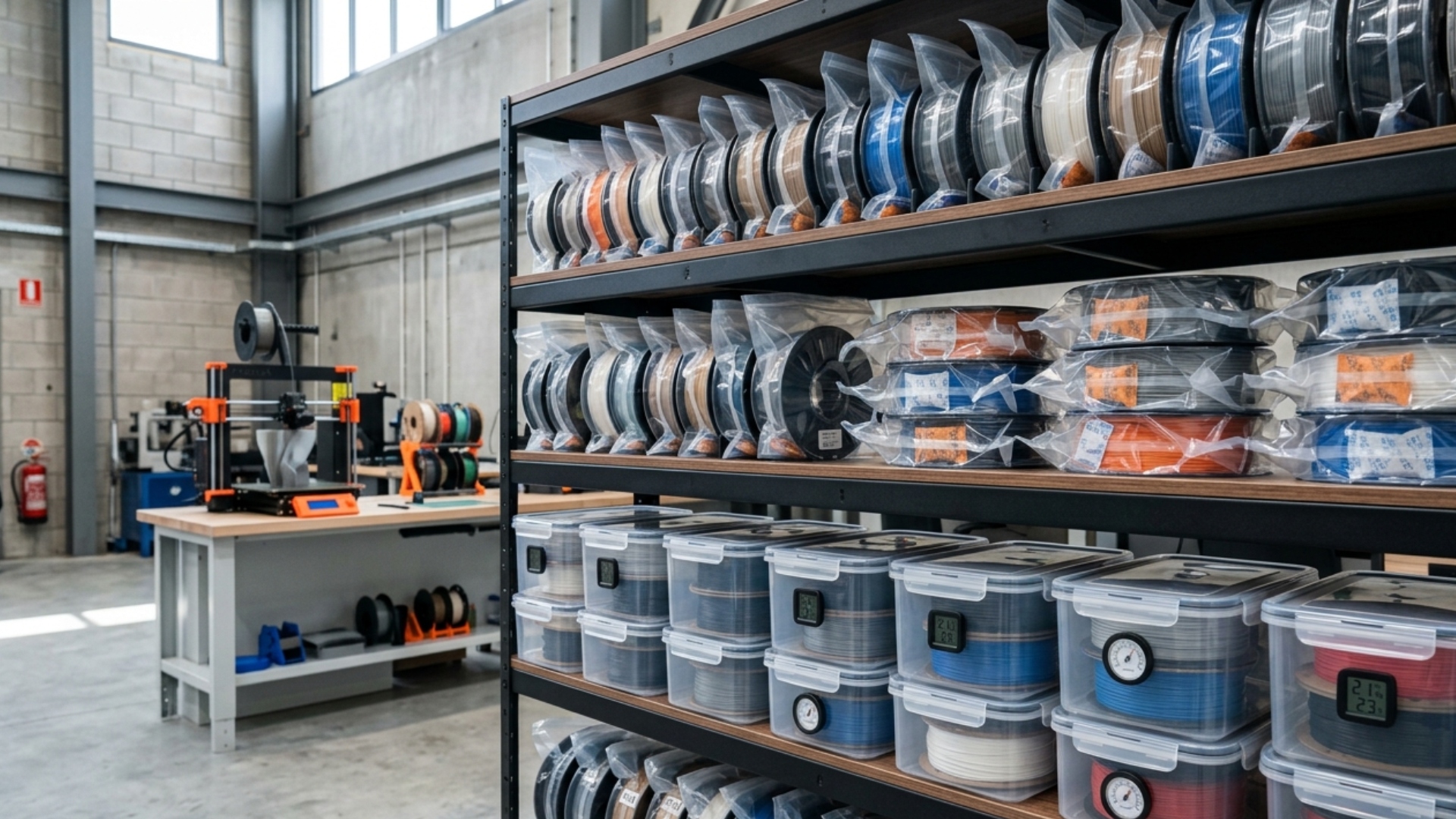
- Keep filaments cool between 20 and 25°C. Use sealed containers with desiccant packs or drying cabinets.
Example
A resin lab once struggled with parts coming out different sizes each time. Then they shifted where they kept the material – no longer near windows where sun could reach. Temperature stayed fixed at 22 degrees. Results became predictable.
Moisture Control
Moisture hiding in filament? Best pull it out below 0.1% before anything important. Tiny tweaks in surroundings often bring surprisingly steady results.
Safe Handling Guidelines for Equipment Operators
Metal Powders
- Before opening any container, make sure operators are properly grounded.
- Start by adding the powders a little at a time so they don’t scatter.
- After every build, run the powder through a sieve between 15 and 20 micrometers for delicate SLM material.
Resins
- Give it a stir each time you top up – around half a minute should do.
- Empty the tank before adding another type of resin.
- Filter the resin before reuse.
- Verify material compatibility before mixing.
Filaments
- Spools shouldn’t stay exposed long when air feels damp.
- Once done, place spools in a dry storage area immediately.
Tracking Expiry Dates And Batch Numbers
When different materials, batches, or reused rounds pile up, keeping track stops being optional.
A Good Log Records
- Batch number
- Manufacturing and expiry dates
- How many times it can be used again
- Powder refresh ratios (e.g., 30% fresh / 70% used)
- Resin refill and mixing times
- Filament drying cycles and moisture readings
Examples
- A dental lab noticed rough surfaces on crowns because resin was nearly two years past production date.
- A medical device supplier found a 0.12 mm size variation only in components using resin stored more than sixteen months.
Recycling And Reusing Materials Properly
Metal Powders
- Five to twenty reuses usually happen, depending on alloy type and oxygen exposure.
- Oxygen increases over time, affecting melt consistency and mechanical properties.
Example
Particles exposed to oxygen melted poorly, reducing edge bonding when Inconel feedstock exceeded reuse recommendations.
SLS Powders
- Typical ratios use 30% new material and 70% recycled material.
- Excessive recycled content reduces elongation and strength.
Example
One manufacturer reduced waste significantly by maintaining strict refresh ratios and inspecting every build.
SLA Resins
- Can be filtered through 190–220 µm filters after long builds.
- Cannot be reused indefinitely due to UV contamination and partial curing.
Filaments
- Dry for four to six hours at 60–80°C after extensive exposure.
- Ensure material is fully dry before reuse.
Rule of Thumb
When reuse happens without tracking, it loses value. Monitoring keeps the process reliable.
Packaging Standards Are The Initial Quality Check
Metal Powders
- Sealed foil-lined packaging protects against oxygen and moisture.
- Nitrogen-filled packaging reduces contamination risks.
Resins
- Thick HDPE containers block light exposure.
- Transparent containers increase the risk of premature curing.
Filaments
- Sealed packaging prevents moisture absorption.
- Humidity indicators and desiccants provide additional protection.
Quick Check
- If humidity indicators exceed 30% RH, dry the spool before use.
- Reject packaging that appears crushed, resealed, or damp.
Contamination Affects Print Quality
Hidden contamination often appears only after the final part is produced.
Examples
- A 50 µm dust particle in metal powder can create porosity and reduce tensile strength.
- Filament with 0.3% moisture can create voids during extrusion.
- Resin containing 1–2% partially cured material can introduce dimensional errors between 0.1 and 0.3 mm.
Aerospace Example
A tiny dust particle contaminated powder during handling, causing density test failures. Improved material management solved the issue.
Digital Inventory Management Systems
When several machines run on different shifts with varied crews, handwritten records quickly become unreliable.
Digital Systems Can Track
- Remaining shelf life
- Reuse counts per batch
- Consumable usage per print
- Temperature and humidity logs
- Procurement forecasts
- Operator-level access records
Example
Systems using QR codes with Airtable or Notion can reduce waste by 15–30% and lower scrap rates significantly.
How To Dispose Of Old Or Dangerous Materials
Resins
- Cure fully under UV light before disposal.
- Ensure complete hardening before handling as waste.
Metal Powders
- Send unused materials to licensed recycling facilities.
- Exercise additional caution with titanium powders.
Polymer Powders
- Follow local disposal regulations.
- Review requirements carefully when additives are present.
Material Certification And Quality Verification
Documentation for each batch should include:
- Chemical composition
- Oxygen and nitrogen content for metal powders
- Flowability and particle-size distribution
- Viscosity and cure profiles for resins
- Moisture and mechanical properties for filaments
When metal powder exceeds acceptable oxygen levels, mechanical performance decreases. Likewise, resin viscosity variations can create dimensional inaccuracies and surface defects.
Shop Floor Materials Checklist
- Check humidity levels and confirm materials remain within specifications.
- Minimise open-container exposure during shifts.
- Store resin in cool, dark locations.
- Keep filament sealed and dry before critical prints.
- Track batch information, expiry dates, reuse limits, and drying cycles.
- Sift powders and filter resins before use.
- Reject damaged or moisture-contaminated packaging.
- Dispose of leftover materials through approved recycling and disposal channels.
Final Thoughts
A solid material management approach affects strength, surface quality, dimensional accuracy, machine wear, and production cost. Advanced systems are helpful, but consistent storage, handling, and tracking practices remain the foundation of successful 3D printing operations. Send a message to us.