


Have you ever wondered how elaborate geometries and complex metal pieces are made without using machining? Metal Resin 3D Printing, a transforming manufacturing technique that blends the strength and durability of metal components with the flexibility of resin-based printing, holds the key to the solution.
Table of Contents:
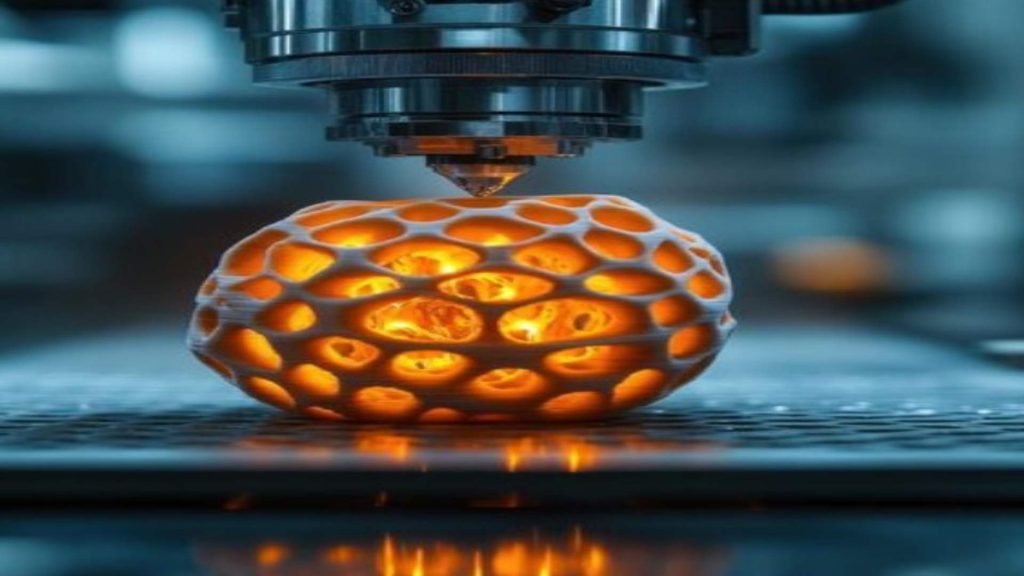
Moreover, Metal Resin 3D Printing is a modern additive manufacturing technique that prints intricate pieces layer by layer. The process is executed using a photopolymer resin injected with small metal particles. After printing, the item undergoes sintering and debinding, which excludes the resin binder and combines the metal particles to form a dense, useful metal part.
Additionally, at CustomMetal3DPrinting, we use state-of-the-art technologies to provide precise, affordable solutions suited to meet your company’s needs.
Step-by-Step Process of Metal Resin 3D Printing
By understanding its workflow, you can better appreciate the accuracy and efficiency of Metal Resin 3D printing. The steps, like design and file preparation, printing with metal-filled resin, debinding, and sintering, are commonly included in the process:
1. Design and File Preparation
A 3D CAD model is the starting point for the adventure. Engineers use sintering shrinkage when optimizing designs for additive manufacturing. Moreover, a sophisticated slicing program gets the file ready for printing.
2. Printing with Metal-Filled Resin
In this step, light is used to selectively cure a specialty 3D printing resin that has been mixed with metal powders (usually utilizing LCD, DLP, or SLA technology). Hence, layer by layer, the resin solidifies to form a “green part” that is composed of metal and polymer.
Although this step is similar to conventional resin 3D printing, the material composition makes a big difference. After post-processing, the presence of metal particles ensures the finished product will have metallic qualities.
3. Debinding
The green portion is debound after printing to eliminate the polymer binder. Thus, depending on the tools and materials, this can be accomplished thermally or chemically.
4. Sintering
The part is heated to a high temperature near the metal’s melting point in a controlled furnace during the sintering process. Moreover, a dense, solid metal structure is created when the metal particles combine. Hence, the end product is a sturdy metal part with superior mechanical qualities.
Additionally, Metal Resin 3D Printing is an effective and scalable alternative for prototypes, functional parts, and even end-use components because of its comprehensive workflow.
Types of Metal 3D Printing Technologies
Despite being a potent strategy, metal resin 3D printing coexists with other metal additive manufacturing methods. You can choose the ideal solution for your application by being aware of these.
1. Bound Metal Deposition (BMD)
Metal Resin 3D Printing and Bound Metal Deposition are closely linked. Similar debinding and sintering procedures are used, and metal powder is bound in a polymer matrix. Thus, this approach is renowned for:
- office-friendly functioning,
- reduced expenses, and
- safety
2. Powder Bed Fusion (PBF)
Powder Bed Fusion melts metal powder selectively using an electron or laser beam. It also demands rigorous safety procedures and industrial-grade equipment despite high accuracy.
3. Directed Energy Deposition (DED)
DED uses concentrated thermal energy to combine the metal once deposited. Moreover, it is perfect for applications involving large parts and repairs.
4. Metal Binder Jetting
Binder jetting is the process of applying a liquid binder to layers of metal powder. It needs post-processing via sintering. The process is similar to Metal Resin 3D Printing.
Moreover, it is unique among them because it strikes a balance between
- cost-effectiveness,
- safety,
- design flexibility, and
- scalability.
Hence, making it perfect for small to medium-sized businesses and rapidly evolving production settings.
Core Principles Behind Metal Resin 3D Printing
Comprehending the fundamental ideas that underpin Metal Resin 3D Printing efficacy is essential to understanding it completely:
- Additive Manufacturing
Layer-by-layer construction reduces waste and enables the addition of complex shapes.
- Material Hybridization
Manufacturers can now fabricate metal components using resin-based systems. They can do so by combining metal powders with 3D printing resin.
- Controlled Thermal Processing
For accurate density, strength, and dimensional correctness, debinding and sintering are precisely calibrated.
- Design Freedom
Using the foundations of resin 3D printing, engineers may create
- interior channels,
- lattice structures, and
- powerful yet lightweight designs
Advantages of Metal Resin 3D Printing
Metal Resin 3D Printing is widely used across industries due to its ample benefits:
1. Cost-Effective Production
Tooling costs are far lower than in traditional metal fabrication. Also, short production runs become economically viable.
2. Design Complexity Without Extra Cost
Complex shapes and complex interior channels can be printed without surplus machining.
3. Reduced Waste
By using only the necessary materials, additive methods support sustainable production objectives.
4. Faster Prototyping
Businesses may swiftly go from concept to production through rapid iteration cycles.
5. Scalability
Prototypes and batch production are two examples of how Metal Resin 3D Printing easily adjusts to varying volumes.
How is Metal Resin 3D Printing applied across industries?
Metal Resin 3D Printing is transforming multiple sectors, including:
- Aerospace: Lightweight structural components
- Automotive: Custom brackets, engine parts
- Medical: Surgical tools and patient-specific implants
- Industrial Manufacturing: Jigs, fixtures, and tooling
Furthermore, before moving on to metal manufacturing, design possibilities are being expanded in the prototyping and concept validation phases by developments in multicolor resin printing. Although multicolor applications are more frequently used in visual prototyping, they improve design verification procedures and enhance metal additive workflows.
How Metal Resin 3D Printing Compares to Traditional Methods
In traditional machining, materials are carved away from a solid block using subtractive methods. This frequently leads to:
- High material waste
- Longer lead times
- Limited design freedom
On the other hand, Metal Resin 3D Printing offers accuracy, speed, and reduces operational complexity. Additionally, it eliminates the expensive molds or dies. The complete procedure makes it ideal for on-demand manufacturing.
Why Choose CustomMetal3DPrinting.com?
The technical expertise and modern Metal Resin 3D Printing capabilities are combined at CustomMetal3DPrinting.com to provide:
- High-density, durable metal components
- Rapid turnaround times
- Design optimization support
- Competitive pricing
Moreover, our staff guarantees accuracy and performance at every level. It is regardless of whether you require working prototypes or final components.
Furthermore, we design solutions that give your company a competitive advantage beyond print parts.
Winding Up
Complex metal components may be produced more intelligently and effectively with Metal Resin 3D Printing. Moreover, this technology is changing how industries make essential parts. It could range from creative design freedom to economical production and reduced waste.
Furthermore, the moment to use Metal Resin 3D Printing is now if you’re prepared to turn your concepts into high-performance metal parts.
Get Started Today!
Collaborate with CustomMetal3DPrinting.com to quickly, accurately, and dependably identify your concepts.
For a free consultation and to learn how Metal Resin 3D Printing can support your next breakthrough, get in touch with us today.