

Discover the Creativity of the Future: Use 3D Printing to Bring Your Ideas to Life
Suite 20-01 & 20-02B, Level 20 The Pinnacle, Persiaran Lagoon, Bandar Sunway, 47500 Subang Jaya, Selangor, Malaysia
hello@custommetal3dprinting.com
+60 124838830
We are a pioneer and a leader in modular 3D printing solutions, celebrates the success of 3D Printing in Silicone: the choice of this material, its benefits, its extrusion compared to conventional methods, and the users’ cases within the framework of Industry 4.0. Discover how R&D team has established the fundamentals and conducted daily research to innovate and change the rules of the game to go beyond the current limits of liquid 3D printing.
Table of Contents:
Silicone is the generic name given to a family of polymers called polysiloxanes. This family covers a wide range of materials that differ significantly in their physical state, molecular structure, and mechanical and chemical properties. Common to all these materials is the presence of silicones in their molecular structure. The particularity of this polymer is the ability to move silicone chains: the bonds between oxygen and silicon allow a wide range of motion, resulting in extremely soft polymers at room temperature. Silicone polymers can exist in various forms depending on the nature of their macromolecules, their size, and their molecular weight distribution. There are oils and gums (used as additives, lubricants, hydraulic fluids), gels (used in breast implants, bicycle seats), and elastomers. The most common form of silicone is silicone elastomer.
An elastomer is the crosslinked form of silicone polymers (three-dimensional network of silicone chains) giving them their typical elastic properties. Elastomers can also contain reinforcing additives and fillers to improve mechanical and thermal properties. There are several types of silicone elastomers distinguished by the method of curing.
RTV1 (Room Temperature Vulcanization mono-component) are presented in the form of a viscous liquid composition, which is cured by moisture in the air. The cure mechanism of such silicones is a polymerization reaction that occurs at room temperature. However, the exothermic nature of this reaction is manifested by the evolution of by-products (such as acetic acid), restricting the use of such silicones. A typical application for RTV1 elastomers is glue, sealant, adhesive compositions, and hand-molded sealant, including bathroom applications.
RTV2 (Room Temperature Vulcanization two components) are two liquid components, the consistency of which is relatively fluid but comparable to that of water. The curing of RTV2 elastomers is also carried out at room temperature, however, by mixing two components in certain proportion. Due to the high degree of fluidity, such silicones are most often used in molding applications for casting or impressions. Unlike RTV1, RTV2 curing does not produce any by-products, which makes them great for medical applications. In addition, such silicones are suitable for use in food processing and in applications involving direct contact with the skin.
HCR (High Consistency Rubber) is a silicone rubber in the form of a plastic mass or pasty consistency, which is processed mainly in internally mixed rubber machines to produce various products. Such silicones are characterized by high tensile strength, resistant to tearing, abrasion, and aging. This group of silicones is traditionally used in engineering: for the production of gaskets, hoses, and cable insulation.
LSR (Liquid Silicon Rubber) are liquid silicone rubbers, which traditionally consist of two components. The consistency of each component is quite thick and viscous, and they must be mixed and cured at elevated temperatures. Liquid silicone rubbers belong to the group of silicones that have the best mechanical properties among all groups and offer the widest range of hardness options. They are used in medical devices (especially those in contact with the skin), in cosmetics, in the food industry. Of all the technical rubbers, silicones are most suitable for use in aggressive environments (resistance to solvents, hydrocarbons, and weathering) and can operate at temperatures from -50 °C to + 250 °C on average.
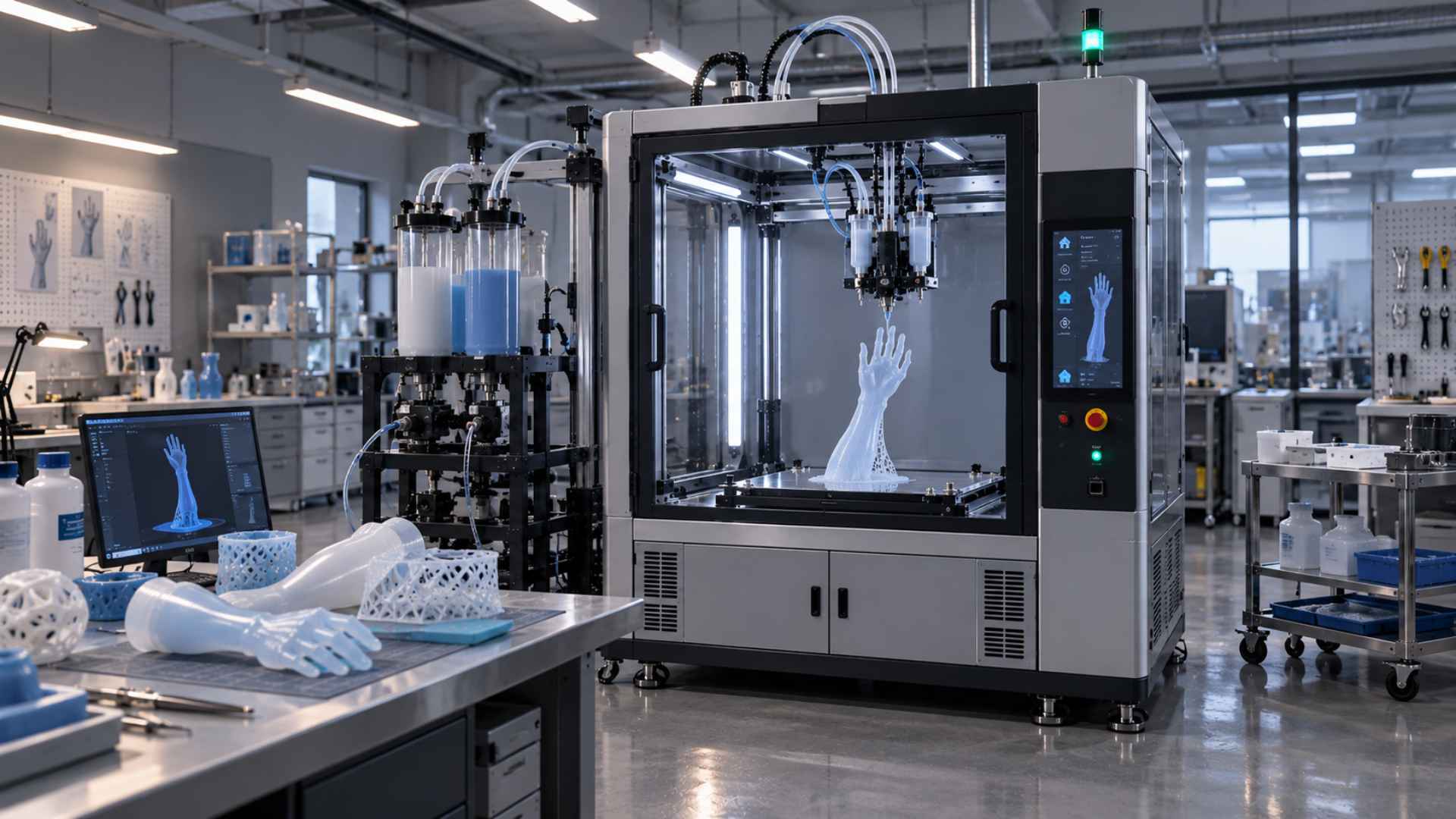
To print liquid materials, a special dosing system is used, which includes volumetric pumps and connectable syringes with a piston. The printing heads LIQ11 and LIQ21 were specially developed for this purpose. Syringes with liquid materials are subject to pressure (using compressed air), which causes the liquid to flow into the volumetric pumps. The pumps are responsible for transporting the material and dosing it with high precision. It is then sent through a precision nozzle attached to the printing head. Thus, the LIQ21 printing head, which is designed to print two-component materials, has a static mixer, through which the material passes from the pumps to the nozzle. This station ensures uniformity of the mixture of two liquid components.
The principle of 3D printing of liquid materials is similar to the working principle of thermoplastic 3D printers using the FFF/FDM/MEX technology. However, instead of extruding and cooling down the thermoplastic polymer, the printing head deposits a bead of liquid material on the build platform and then moves to the next layer. Each newly deposited layer adheres to the previous one: the physical and chemical properties of the printed polymer can withstand this additional load. This is made possible by the special rheological properties of the liquid material: a liquid polymer can adhere to itself without collapsing. After the end of the printing process, the cross-linking of the polymer occurs, which provides the printed part with the necessary mechanical properties. Therefore, the materials that can be printed using this technology are thermosetting polymers (which have elastomeric properties in the case of silicones).
One of the advantages of 3D printing technologies is their ability to respond quickly to changing needs. In the case of silicone materials, these technologies are used to print parts for rapid prototyping or to solve shortages. In addition, 3D printed parts are made of a “good” material and are immediately ready for use. Thanks to the elimination of the molding stage, it becomes possible to iterate the design more often and more quickly, which reduces the time and cost of prototyping. At the same time, when mastering the CAD, it is possible to optimize the design by reducing the weight of the part due to the possibility of designing the porosity.
Parts printed on the S600D or the S300X – LIQ21 | LIQ11 have mechanical properties comparable to parts manufactured by conventional casting or molding methods. The ability to print liquid materials allows creating covalent bonds between layers, thereby obtaining completely isotropic parts. The technology of 3D printing of silicone elastomers opens up new opportunities in the fields of personalized medical devices, patient monitoring, or even customized devices in other sectors. It also allows for adjusting the device by modifying the CAD file: for example, without the need to take a new impression.
For applications such as 3D Printings Silicone Molds, Silicone Mold 3D Printing, and 3D Printing for Silicone Masks, the flexibility and customizable properties of silicone make it suitable for producing specialized components and prototypes. Connect with us now.
