

Discover the Creativity of the Future: Use 3D Printing to Bring Your Ideas to Life
Suite 20-01 & 20-02B, Level 20 The Pinnacle, Persiaran Lagoon, Bandar Sunway, 47500 Subang Jaya, Selangor, Malaysia
hello@custommetal3dprinting.com
+60 124838830
3D Printing Technologies or Additive manufacturing technology helps in fabricating three-dimensional objects from digital geometrical designs by the method of progressive layer deposition. In recent years 3D printing technology has seen exponential development in the manufacturing field, be it automobile, aerospace, healthcare, fashion, textiles and many more. Looking back into the history of 3D printing or additive manufacturing technology it was developed and commercialized by Charles Hull in 1980.
Table of Contents:
Businesses often explore modern manufacturing solutions to support product development and production. Many also search for 3D Printing Services Nearby when they require faster turnaround times and local assistance.
After years of research and developments numerous 3d printing/additive manufacturing technologies have been identified based on their application and working principle, as per the ASTM standard (F2792), there are 7 categories of 3D printing technologies which are listed below,
There are no proper discussions on which 3d printing technology is best, because every 3d printing technology or 3d printing machine is developed to meet the demand of specific applications or needs.
Vat photopolymerization is an old 3d printing technique that fabricates 3d printed parts by curing the liquid photopolymer resins using the laser or uv-light source. Photopolymer is a type of polymer that undergoes a chemical reaction and change its property from liquid to solid-state when gets exposed to light. The vat photopolymerization methods are further categorized into two types based on their working principles, they are Stereolithography(SLA) and digital light processing(DLP).
The powder bed fusion technology (PBFT) consist of three methods i.e., electron beam melting or EBM, selective laser sintering or SLS, and selective heat sintering or SHS. All the above-mentioned methods uses an electron beam, laser source, thermal head to melt the powder-based materials in order to fuse together and form a 3d printed part. In the year 1987 Carl Deckard invented one of the powder bed fusion technologies i.e., selective laser sintering or SLS. The PBFT makes use of metal, ceramic, and polymer powder materials to produce 3d printed parts.
The directed energy deposition (DED) additive manufacturing technology utilizes an electron beam, laser or plasma arc as an energy source to melt the powdered or wired material. The DED method uses the same principle as the material extrusion method, but in this method both material and energy are fed from a nozzle that can move and rotate in all directions as opposed to the material extrusion in which the nozzle can only move in x,y,z directions.
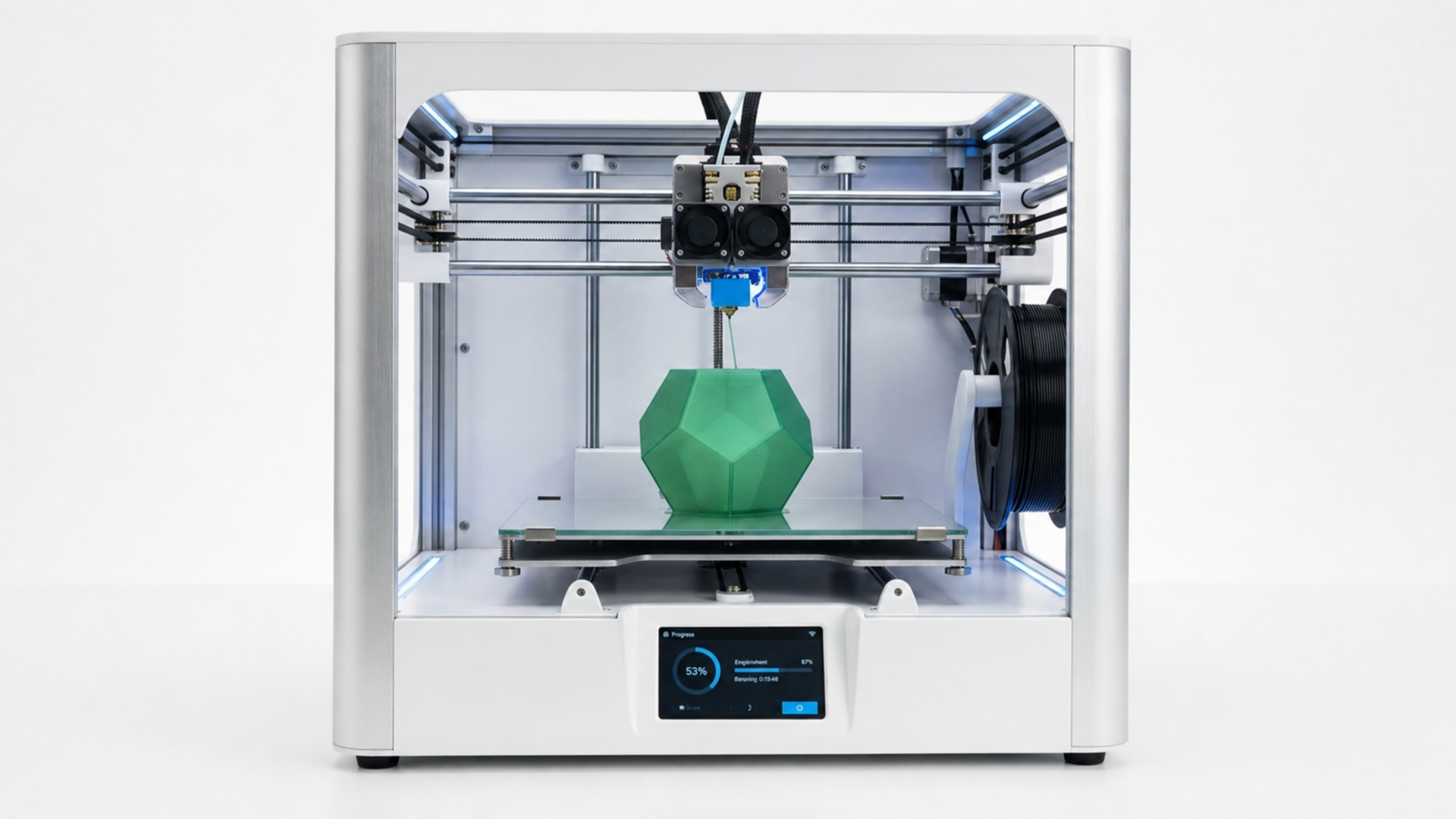
3D Printing Technologies also include Material Extrusion methods, also known as fused deposition modelling (FDM) or fused filament fabrication (FFF). Fused deposition modelling uses a continuous filament in the form of a wire made up of thermoplastic or composite materials to create 3d parts from a digital design. It is considered to be one of the simplest and most accessible 3d printing technologies among all seven technologies mentioned above. In this process, thermoplastic materials in filament form are heated and extruded through a nozzle to build objects layer by layer.
Binder Jetting is widely used in 3D Printing Services where a jet of binder is used to bind powder particles together. It works similarly to inkjet printing, where the binder is deposited onto powder layers to form solid structures. The process repeats layer by layer until the final object is formed. This technology supports metals, ceramics, polymers, and sand materials, making it highly versatile.
Material Jetting is one of the most precise where droplets of photopolymer material are deposited and cured using UV light. This method delivers high accuracy and smooth surface finish, and it is commonly used for multi-material and full-colour parts.
Sheet Lamination is another category of 3D printing applications in industrial environments. It builds parts by bonding sheets of material together layer by layer. Techniques include Laminated Object Manufacturing (LOM) and Ultrasonic Additive Manufacturing (UAM), which uses vibration to bond metal sheets.
For companies or individuals exploring 3D Printing Nearby, understanding these technologies helps in selecting the right manufacturing method. Connect with us right now.Whether using advanced production systems or exploring 3D Printing Services, additive manufacturing continues to transform industries through faster and more efficient production methods.
