

Discover the Creativity of the Future: Use 3D Printing to Bring Your Ideas to Life
Suite 20-01 & 20-02B, Level 20 The Pinnacle, Persiaran Lagoon, Bandar Sunway, 47500 Subang Jaya, Selangor, Malaysia
hello@custommetal3dprinting.com
+60 124838830
For generations, 3D Printing Metal Jewelry making has relied on two core methods: handcrafting and lost-wax casting. Both demand a high level of skill, are labor-intensive, and leave little room for error—mistakes can be costly.Today, digital design and 3D printing are transforming these traditional practices. By integrating digital tools into the workflow, jewelers gain new creative possibilities and production efficiencies, while customers benefit from greater customization options.
Table of Contents:
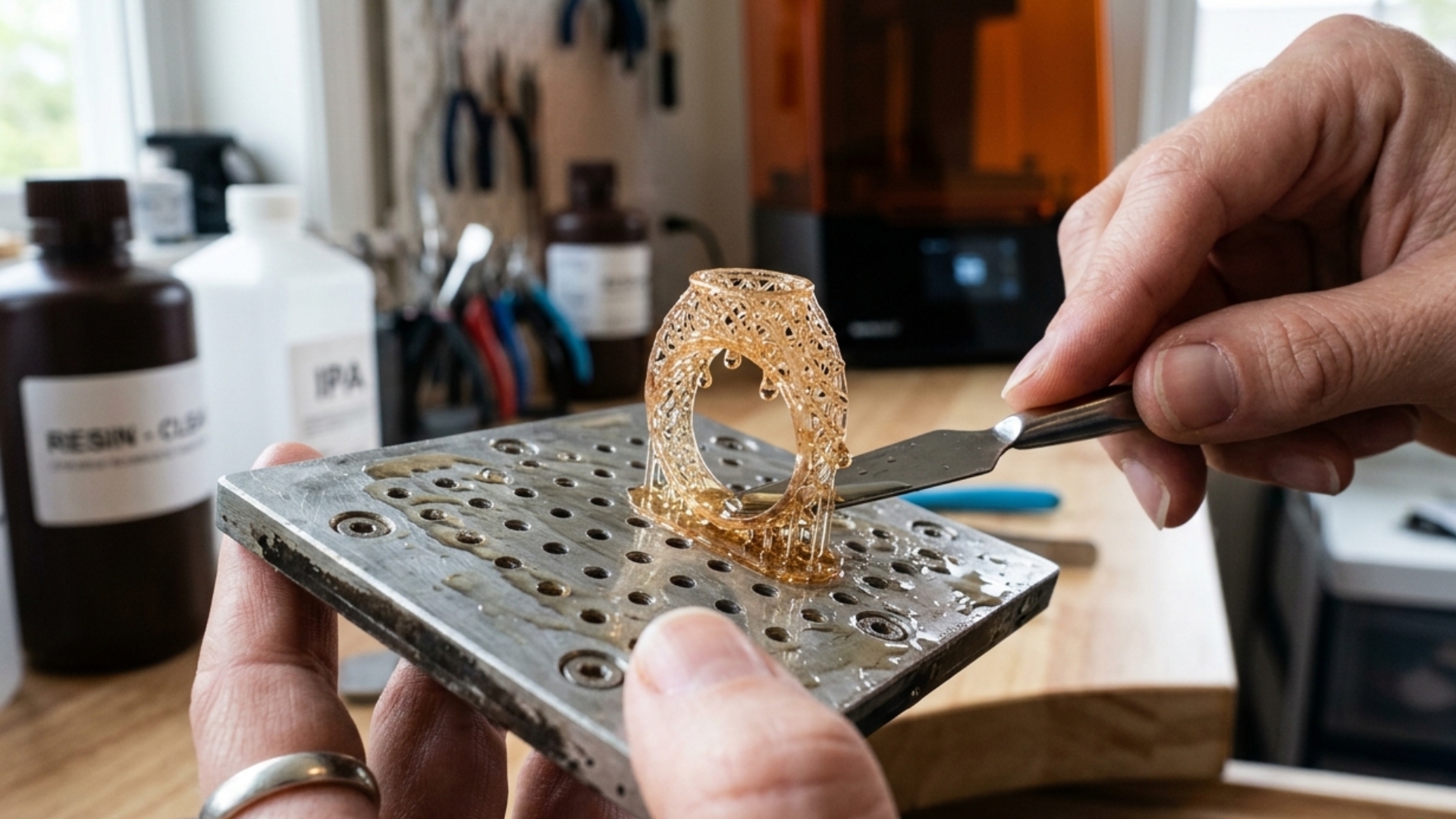
3D Jewelry Printing builds on the established principles of investment (lost-wax) casting but enhances them with digital precision. In conventional casting, artisans carve a wax model by hand, encase it in a mold, burn out the wax, and pour molten metal into the cavity. The final piece is then polished to achieve its finished look.With digital workflows, the process begins with a CAD-designed model, which is 3D printed and post-processed. This printed pattern is used to create a mold, just like in traditional casting. After the burnout phase, the casting proceeds as usual. The key difference lies in the earlier stages: digital modeling and printing replace manual carving, reducing labor time and making designs easier to store, adjust, and reproduce.
Custom 3D Jewelry Printing Service has long been a luxury due to the complexity and cost of production. Now, digital tools allow jewelers to offer personalized pieces as a standard service. For example, when ordering an engagement ring, customers often have the option to co-create a unique design.
3D-printed mock-ups significantly speed up the design feedback process. A jeweler and client can review a concept together, and within hours, the customer can hold and try on a physical prototype. This immediate iteration loop—enabled by on-site design and fast printing—makes customization faster, more interactive, and less expensive. Adjustments can be made digitally, reprinted, and cast using traditional methods, lowering the overall cost of bespoke pieces.
3D printing allows for intricate designs that would be extremely difficult or impossible to carve by hand. Advances in castable resins have raised the bar for quality, even with affordable desktop printers. SLA (stereolithography) printing produces highly detailed, smooth-surfaced models ideal for casting.
Materials like True Cast Resin and Castable Wax Resin are specifically formulated for jewelry applications. True Cast Resin supports fine details such as delicate filigree, raised lettering, and pavé settings, delivering reliable results for pieces up to 5 mm thick. Castable Wax Resin offers high strength and stiffness, enabling ultra-thin structures with excellent shape retention. It contains 20% wax and burns out cleanly with no ash residue.
With these capabilities, designers are exploring new aesthetic frontiers, particularly in regions like the U.S., South Asia, and the Middle East, where digital tools are unlocking innovative styles.
Digital methods also simplify large-scale production. Traditionally, rubber molds used for mass casting require a master model made from hand-carved wax or investment casting. Now, 3D printers can produce precise master patterns directly, suitable for both room-temperature (RTV) and high-temperature vulcanized rubber molds.
As Amos Dudley, Jewelry Vertical Product Manager at Formlabs, explains: “The surface quality from SLA printing is so high that you can go straight from the printed part to a master mold. Minimal finishing is needed, and the result works perfectly for producing final wax components at scale.”
Historically, advanced 3D printing technology was expensive and complex, limiting access to large manufacturers. Earlier systems required significant investment, maintenance, and technical expertise.Now, with more affordable and user-friendly options like the Form 4, digital workflows are within reach for small studios. The system is intuitive—new users can learn it in about 15 minutes—and operates with 99% reliability, minimizing downtime and repair costs. This allows independent jewelers to produce consistent, high-quality work without heavy overhead or a steep learning curve.
Despite its potential, 3D printed jewelry still makes up a small portion of the market, partly due to past cost barriers and the perceived difficulty of digital design. However, as printers become more accessible and easier to use, adoption is growing. Desktop SLA systems like the Form 4 play a key role in this shift, offering speed, accuracy, and consistency across full build platforms.
The outlook is promising. As training in digital techniques becomes more widespread and hardware improves, more jewelers will adopt these workflows. Innovations in materials—such as True Cast Resin—further support efficient, high-detail production.
To explore these benefits firsthand connect with us for more information.
