

Discover the Creativity of the Future: Use 3D Printing to Bring Your Ideas to Life
Suite 20-01 & 20-02B, Level 20 The Pinnacle, Persiaran Lagoon, Bandar Sunway, 47500 Subang Jaya, Selangor, Malaysia
hello@custommetal3dprinting.com
+60 124838830
Using a single material to create intricate forms and “impossible” geometries is known as additive manufacturing. Researchers at MIT and the Singapore University of Technology and Design are looking in a different direction while scientists and designers are concentrating on optimizing the 3D printing process in terms of design and manufacturing with a specific range of rigid materials (such as 3D printing with plastics, resins, or metals). The conventional materials used in 3D printing have nothing to do with shape memory polymers. These materials are designed to undergo form changes over time.Nevertheless, we anticipate the emergence of a new technology: 4D printing, in addition to the ongoing expansion of 3D printing. Let’s examine this recent development in 4D printing services and learn how shape memory polymers have the potential to completely transform the additive manufacturing sector.
Table of Contents:
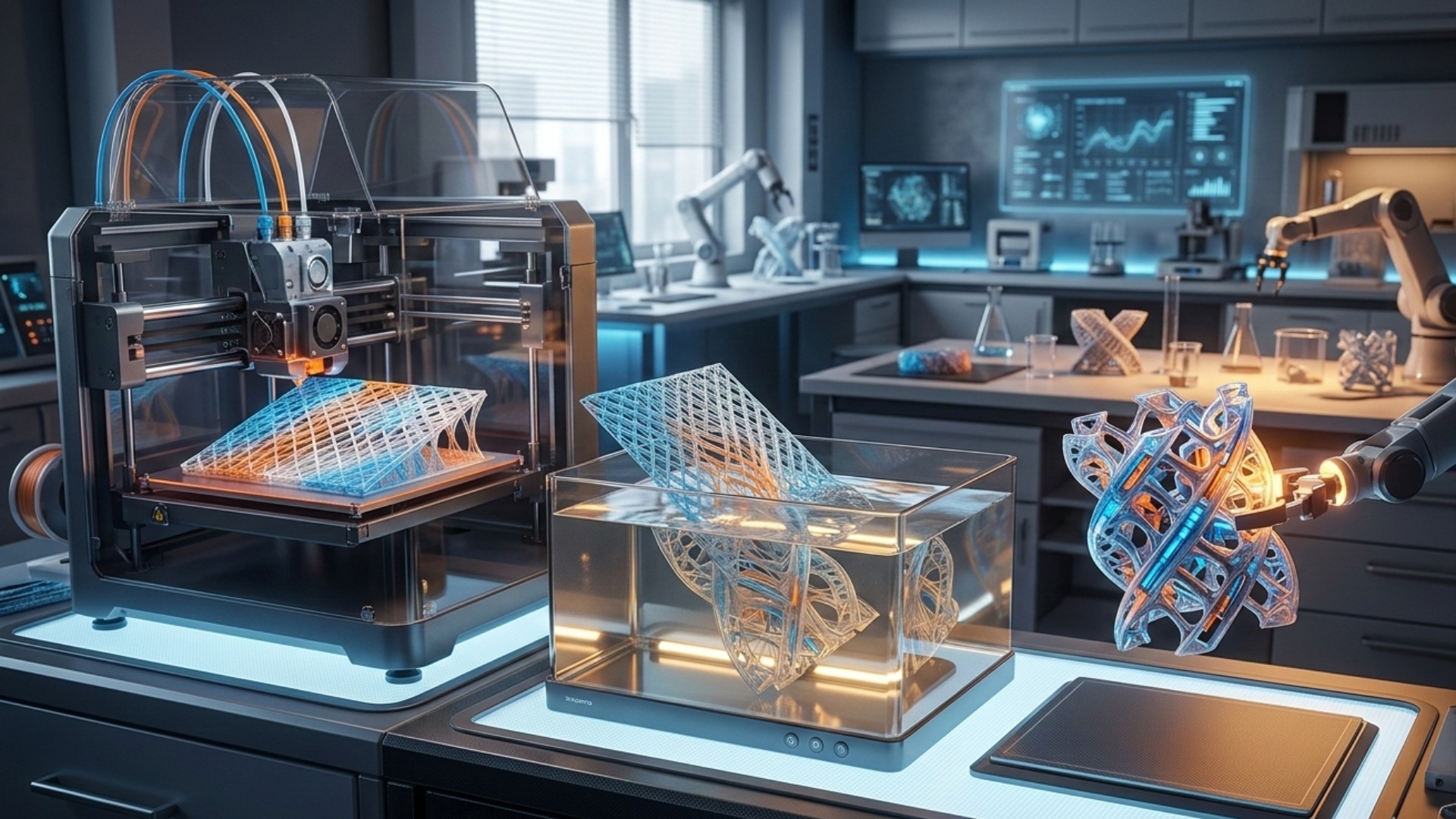
A shape memory polymer (SMP) is a type of material that has the capacity to exhibit significant elastic deformation in response to environmental stimuli, according to the researchers’ paper on the subject. In other words, when an external energy is supplied to it, it can change shape in a variety of ways before returning to its original form. This new type of 3D printing material needs to be exposed to heat, light, electricity, moisture, or an atmosphere with a particular pH in order to bring about this change.
The high-resolution projection microstereolithography (PμSL) method used in the shape memory polymer tests will be explained in the paragraphs that follow. Multi-functional oligomer resins are used as crosslinkers and mono-functional monomer resins as linear chain builders to create the shape memory polymers. A commercial Polyjet 3D printer is utilized to process the two types of resins and transform them into shape memory polymers.
You might be wondering why we discuss 4D printing since shape memory polymers are 3D printing materials. What distinguishes these two technologies from one another, and how are they related?
The goal of 3D printing is to create solid, rigid parts—that is, items that do not change shape when exposed to external energy—as we discussed in the blog post’s opening.
However, 4D printing technology market deals with pre-programmed components of the printed structure that respond when exposed to a stimulus, as our most recent article describes.
In essence, 4D printing is the evolution of 3D printing.
The materials that the two technologies use as input can be used to distinguish between them. Any of the materials now available on the market for 3D printing could be utilized. However, for 4D printing to be successful, a “smart material” is required. Shape memory polymers and hydrogels are regarded as “smart materials.” We described how they function: when solvent molecules permeate the polymer network memory polymer, they swell. Conversely, a shape memory polymer exhibits controllable and programmable shape memory activity and can change into various shapes.
To put it another way, a shape memory polymer is the type of material required for a successful 4D printing process.
One of the most exciting innovations is 4D printing in healthcare, which uses programmable materials to make medical devices that react to biological signals like body temperature.
The application of shape memory polymers will have a favorable impact on numerous fields. It is anticipated that the health sector will be most affected. The medical industry already makes extensive use of additive manufacturing. From 3D printed bones to bioprinting using novel materials, every type of 3D printing material has a variety of uses. It is thought that the usage of shape memory polymers will have a significant impact on those who require technology and medicine, given the ongoing need for innovative 3D printing materials and technologies in the medical field.
Making devices out of shape memory polymers is one potential use. These might be pharmaceutical devices that are placed inside the body and programmed to react to variations in body temperature. For instance, if they detect a fever or other changes in body temperature, they will discharge medication or antibiotics.
The energy sector is another area where shape memory polymers may find valuable uses. Shape memory materials could be used in solar panels that act as sensors to identify the sun and automatically rotate in the proper direction. It will be feasible to create intelligent shape-changing solar panels that autonomously modify their inclination for optimal energy efficiency by fusing robotics and material science.
One thing is certain: shape memory polymers are anticipated to significantly disrupt the engineering industry when they are incorporated into the fields of electronics, healthcare, or energy. Experimenting with new and creative 3D printing materials is a big trend these days, which makes us believe that 4D printing technology could soon become popular.
However, before this new technology is commercialized, scientists still have a long way to go. Until then, you can begin creating your own project and take advantage of all the advantages that 3D printing technology provides.
Are you curious to find out more about cutting-edge additive manufacturing technologies like 3D and 4D printing? Our group is available to assist. We would be pleased to talk about how these technologies can meet your needs, whether you have inquiries regarding cutting-edge materials, new applications, or possible project partnerships.
Please get in touch with us if you would like additional details about our services and expertise. Our professionals are prepared to provide you with expert advice and customized solutions.
